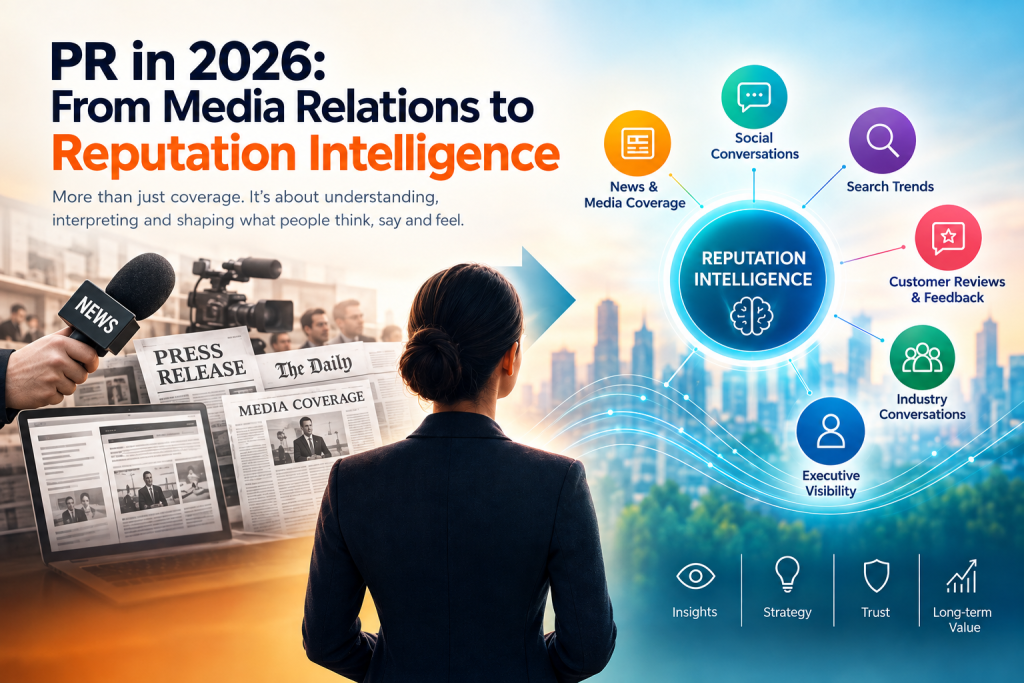
For decades, public relations was largely defined by one question: Can we get the brand into the media?
A strong media story, a prominent publication, a television mention or a well-placed interview were often seen as the clearest indicators of PR success.
But the communications landscape has changed.
Today, brands are being discussed across newsrooms, social media, search engines, podcasts, online communities, review platforms and AI-powered tools. A company’s reputation is no longer shaped by a handful of journalists or traditional media outlets. It is shaped by an always-on conversation involving customers, employees, creators, investors, industry experts and the wider public.
This shift is changing the role of PR.
PR in 2026 is moving from media relations to reputation intelligence.
The End of the “Coverage Is the Goal” Mindset
Media coverage still matters. In fact, credible earned media remains one of the most valuable ways for a brand to establish authority and third-party credibility.
But coverage alone doesn’t tell the complete story.
A brand can receive hundreds of media mentions and still struggle with customer trust. Another brand may receive fewer articles but build strong credibility within a highly relevant industry audience.
The important questions are therefore changing:
- What are people saying about the brand?
- Where are those conversations happening?
- What is driving positive or negative sentiment?
- Which narratives are gaining momentum?
- What questions are customers asking?
- How is the competition being perceived?
- Are emerging issues becoming potential reputation risks?
- Is the brand being associated with the values it wants to own?
This is where reputation intelligence comes in.
What Is Reputation Intelligence?
Reputation intelligence is the ability to continuously collect, interpret and act on information about how a brand, leader or organisation is perceived.
It goes beyond traditional media monitoring.
Traditional monitoring might tell you that your company was mentioned in 50 articles.
Reputation intelligence asks:
What do those mentions mean?
It connects signals from multiple sources to help communication teams understand the bigger picture.
These signals can include:
Earned media:
News articles, interviews, features and editorial coverage.
Social conversations:
Posts, comments, discussions and emerging narratives across social platforms.
Search behaviour:
What audiences are searching for and the questions they associate with a brand.
Reviews and customer feedback:
What customers appreciate, question or criticise.
Industry conversations:
What experts, competitors and opinion leaders are discussing.
Executive visibility:
How founders and senior leaders are being perceived in public conversations.
The objective isn’t simply to collect more data.
It is to turn fragmented information into actionable insight.
From Monitoring to Understanding
One of the biggest changes in modern PR is the evolution from monitoring to interpretation.
Imagine a company notices that negative conversations about one of its products have increased.
A conventional monitoring report might simply flag the increase.
A reputation intelligence approach goes further.
It can help identify:
- when the conversation started,
- which platform accelerated it,
- what triggered the discussion,
- which narratives are spreading,
- who is influencing the conversation,
- what concerns are repeated most frequently,
- and whether the issue is likely to remain isolated or become broader.
This allows communication teams to move from reactive communication to proactive decision-making.
AI Is Accelerating the Shift
Artificial intelligence is playing an increasingly important role in this transformation.
AI can help PR teams process large volumes of information, identify patterns, monitor conversations, summarise coverage, analyse themes, detect emerging topics and support faster content development.
But technology doesn’t eliminate the need for PR expertise.
It makes that expertise more valuable.
AI can identify a pattern.
A PR professional has to determine why that pattern matters, what it means for the brand and what should happen next.
That distinction is critical.
The future isn’t about AI versus PR professionals.
It is about AI empowering PR professionals.
The Rise of Predictive PR
Another important shift is the movement from reactive to predictive communication.
Historically, PR teams often responded to events after they happened.
Today, reputation intelligence can help identify early signals.
A small complaint can become a recurring theme.
A niche industry discussion can become mainstream.
A customer question can reveal a communication gap.
A regulatory development can create a reputational challenge.
An emerging cultural conversation can create an opportunity for a brand to contribute meaningfully.
The earlier communication teams identify these signals, the more effectively they can prepare.
This doesn’t mean predicting exactly what will happen.
It means becoming better at recognising what is starting to happen.
The CEO Is Now Part of the Reputation
Corporate reputation and executive reputation are increasingly interconnected.
Founders and CEOs are no longer communicating only through official company announcements. Their interviews, LinkedIn posts, conference appearances, podcasts and public comments can significantly influence how audiences perceive the organisation.
This makes executive positioning an important part of reputation management.
A strong executive communications strategy should answer:
- What should the leader be known for?
- Which issues can they credibly speak about?
- What expertise can they contribute?
- Which audiences matter?
- How should their personal voice connect with the organisation’s broader reputation?
The goal isn’t simply to make an executive visible.
It is to make that visibility meaningful.
Reputation Is Built Across Every Touchpoint
PR can no longer operate in isolation.
A powerful media campaign cannot compensate indefinitely for a poor customer experience.
A strong advertising campaign cannot completely overcome a credibility problem.
A compelling CEO interview cannot resolve inconsistent organisational behaviour.
Reputation is influenced by what a company says, does and enables people to experience.
That means modern PR teams increasingly need to work alongside marketing, leadership, customer experience, HR, legal and other business functions.
Communication becomes most effective when the message and the experience are aligned.
Measuring What Actually Matters
The PR industry has also been moving beyond traditional measurement.
The number of media clips still has value, but it is only one part of the picture.
Modern reputation measurement can consider:
- quality and relevance of media coverage,
- share of voice,
- message association,
- sentiment and conversation themes,
- audience engagement,
- executive visibility,
- search interest,
- stakeholder response,
- competitive positioning,
- and changes in reputation over time.
The objective is not to create a bigger spreadsheet.
It is to understand whether communication is contributing to the organisation’s broader goals.
The Human Element Still Matters
With all the talk about AI, analytics and automation, it is easy to overlook the most important element of PR: human judgement.
Reputation is ultimately about people.
Trust is human.
Relationships are human.
Empathy is human.
Context is human.
A machine can process thousands of conversations, but deciding how a brand should respond to a sensitive situation requires experience, judgement and an understanding of people.
That is why the PR professional of 2026 is not simply a media relations specialist.
They are increasingly expected to be a strategic interpreter of reputation.
The Future of PR Is Intelligent, Not Just Automated
The evolution of PR isn’t about replacing traditional media relations.
It is about expanding what PR can do.
Media relations will remain important. Storytelling will remain important. Relationships with journalists will remain important.
But they will exist within a much larger ecosystem of data, digital conversations, stakeholder expectations and real-time reputation signals.
The PR agency of the future will need to combine:
Human relationships + strategic thinking + data + technology + storytelling.
That combination can transform PR from a communications function that reports what happened into a strategic function that helps organisations understand what is happening, why it matters and how they should respond.
From Public Relations to Reputation Intelligence
The biggest opportunity for PR in 2026 is not simply generating more visibility.
It is helping organisations understand the environment in which their reputation is being created.
Because today’s most important PR question isn’t:
“How many people saw our story?”
It is:
“What did people take away from it?”
And increasingly, the organisations that understand that distinction will approach communication differently.
PR is evolving.
From media relations to reputation intelligence.
From coverage to context.
From monitoring to insight.
From reacting to anticipating.
And from simply managing communication to helping organisations understand and build the trust that surrounds their name.